

Support at Home
What is Support at Home?
Support at Home represents Australia’s updated approach to funding assistance for independent living. On 1 November 2025, it replaced both the Home Care Packages and the Short-Term Restorative Care Programme.
It is a new program, developed by the Australian Government to align with the new Aged Care Act 2024 and Strengthened Quality Standards.
Key features
- Eight main funding levels, with up to $78,000 for high care needs.
- Annual budgets managed in quarterly amounts.
- Three funding pathways for short-term supports.
- Care management fees capped at 10%.
- Services are grouped into three categories.
What services are available?
Services that the Support at Home can subsidise are grouped into three categories: Clinical Supports, Independence and Everyday living.
Click here to read the services available with Adssi In-home Support.
Clinical Supports
Specialised services that support older adults in maintaining or regaining function and cognition, provided directly or supervised by trained health professionals to ensure safe, high-quality care.
- Nursing care.
- Allied health and other therapeutic services.
Independence
Support delivered to older people to help them manage activities of daily living and the loss of skills required to live independently.
- Personal care.
- Social support and community engagement.
- Respite.
- Transport.
- Assistive technology and home modifications.
Everyday living
Support to assist older people to keep their home in a liveable state in order to enable them to stay independent in their homes.
- Domestic assistance.
- Home maintenance and repairs.
- Meals.
Download our Support at Home Brochure.
If your Notice of Decision letter includes services not listed here, we can help arrange them for you.
Read the full Support at Home service list on the Australian Government website.
Who’s eligible & how it works:
Am I eligible?
You may be eligible for Support at Home if you:
- Need help to live safely and independently at home (e.g., with personal care (like showering), daily tasks, mobility, health or social connection).
- Are older (most people are 65+, or 50+ for Aboriginal and Torres Strait Islander people).
- Meet residency requirements for Australian Government–funded aged care.
Visit My Aged Care now and check your eligibility.
If you're younger and living with disability, the NDIS is usually the right pathway—but talk to us if you're unsure; we'll point you in the right direction.
How it works (step by step)
Start with My Aged Care
Call 1800 200 422 or visit myagedcare.gov.au. They'll do a quick phone screen about your day-to-day needs. You can have a family member or friend listed as your support person.
In-person assessment
If needed, an assessor meets you (usually at your home) to understand your goals, safety, health, and living situation. Bring any reports or scripts (e.g., from your GP, physio or OT).
Decision & plan
You'll receive a Notice of Decision and a support plan. This includes your Support at Home classification (which sets your quarterly budget) and any approvals for short-term supports or Assistive Technology/Home Modifications.
Choose your provider
Your Care Partner will co-design your service schedule (based on your Notice of Decision), book visits, and keep everything on track.
Download our Support at Home brochure and contact us.
Set up services
We will schedule the support you were assessed and approved for. Services can start once your plan is active.
Download our Adssi App to schedule your services.
Contributions & pricing
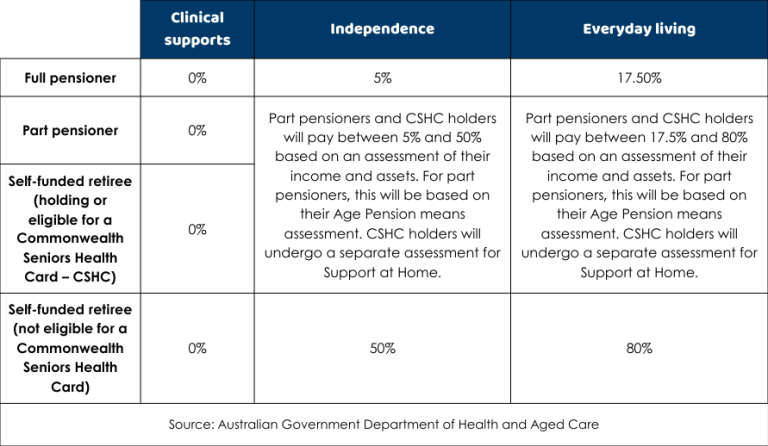
Support at Home participants pay contributions towards their services, based on an assessment of their income and assets from Services Australia.
Contributions will differ for the different service groups:
- Clinical supports – no contribution.
- Independence – moderate contributions.
- Everyday living – highest contributions.
Standard participant contribution rates from 1 November 2025:
Home Care Package (HCP) recipients and older people approved for a package on or before 12 September 2024 will be no worse off under Support at Home. This means they will make the same or lower contributions than they were assessed as having to pay under HCP arrangements.
Read more about HCP recipients who move across to Support at Home.
Care Management
When you become an Adssi client, your dedicated Care Partner works with you to understand your goals, create and update your care plan, coordinate services, and check in regularly so your support keeps pace with your life. This is an ongoing service for every Support at Home participant.
10% of your Support at Home budget is set aside for care management each quarter to ensure smooth service operation.
Resources:
Helpful Support at Home resoruces from the Australian Government.
Factsheet: Support at home program – Aboriginal and Torres Strait Islander people
Factsheet: Support at Home program – Assistive technology and home modifications (AT-HM) scheme
Factsheet: Support at Home program – Care management
Factsheet: Support at Home program – Classifications and budgets
Factsheet: Support at Home program – End-of-Life Pathway
Factsheet: Support at Home program – Participant contributions
Factsheet: Support at Home program – Restorative Care Pathway
Factsheet: Support at Home program – Self-management
Factsheet: Support at Home program – Services
Factsheet: Hardship assistance for aged care
Support at Home booklet for older people, families and carers
Support at Home booklet for older Aboriginal and Torres Strait Islander people
Consumer protections for Support at Home prices – fact sheet for participants
Checklist: What you need to do to prepare to move to Support at Home
Subscribe to aged care newsletters and alerts
For more help, you can also contact My Aged Care on 1800 200 422.